
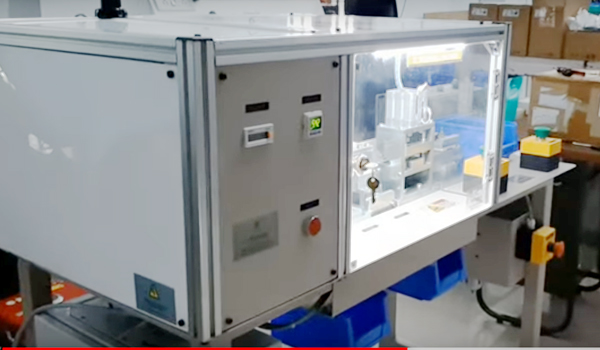
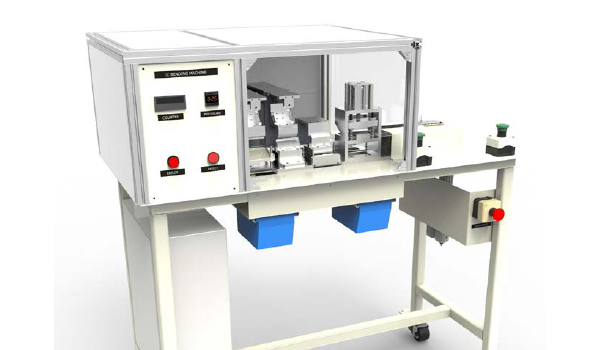
IC, Resistors, and Diodes for PCB manufacturing especially for the automotive industry require the leads to be in different shapes. In all cases, these products come in reel form. To make the leads to the required shape, enProducts® automatic bending machines are the best solution when precision and volume are required. This IC lead bending machine is one of our servo-controlled bending machines, productive and reliable.
Frequently asked questions
What is an IC lead bending machine used for?
An IC lead bending machine is used to precisely bend IC leads to a defined angle, pitch, and form before PCB assembly or downstream processes. It ensures uniform lead geometry, prevents stress damage, and improves assembly consistency.
Can the machine process ICs supplied in strip or plastic container packaging?
Yes. The machine can be designed to handle ICs supplied in strip format housed in plastic containers, with controlled feeding and indexing to avoid lead damage or misalignment during handling.
Is the machine compatible with IC model IMZA120R040M1H?
Yes. The machine can be custom-engineered to match the exact lead configuration, pitch, body size, and bending requirements of IC model IMZA120R040M1H, based on component drawings and sample validation.
How consistent is the lead bending accuracy?
High consistency is achieved using precision tooling, controlled actuation, and rigid fixtures. This ensures uniform bend angle and lead geometry across all ICs, minimizing variation that could affect PCB assembly or soldering quality.
Will the bending process damage IC leads or the IC body?
No. The bending process is designed to apply controlled force within allowable limits, ensuring that IC leads are bent without cracking, stress marks, or deformation of the IC body.
What production volumes can the machine support?
The machine can be designed to support low, medium, or high production volumes depending on cycle time requirements, feeding method, and automation level. This makes it suitable for both pilot runs and mass production.
Is the machine expensive compared to manual or semi-automatic methods?
While the initial investment may be higher than manual methods, automation significantly reduces operator dependency, rejection and rework, and inconsistent bending quality. Over time, this results in a lower cost per part and predictable output.
Can the machine be customized for future IC variants?
Yes. The machine can be designed with modular tooling and adjustable parameters, allowing it to adapt to future IC variants with similar form factors through tooling changes rather than a complete redesign.
Does customization increase lead time significantly?
Customization is a standard part of IC lead bending machines. Lead time is planned with design validation, sample trials, and acceptance testing to ensure the machine meets functional and quality expectations before delivery.
Does the machine comply with industrial and quality standards?
Yes. The system can be designed using industrial-grade mechanical, electrical, and control components, with proper safety guarding and interlocks, making it suitable for regulated manufacturing environments.
How reliable is the machine for continuous operation?
The machine is built for continuous shop-floor operation using proven industrial components, ensuring stable performance, minimal downtime, and ease of maintenance.
What level of operator skill is required?
The machine requires minimal operator skill. Typical tasks include loading IC strips, basic monitoring, and part collection, reducing dependency on highly skilled manpower.
What inputs are required to finalize the machine specification?
To finalize the design, inputs typically include the IC datasheet or drawing, lead bending specifications, production volume targets, packaging details, and quality or inspection requirements.
Why do manufacturers prefer automated IC lead bending over manual bending?
Automated IC lead bending ensures repeatable quality, higher throughput, reduced operator fatigue, and improved downstream assembly performance, which is critical for electronics and automotive applications.