
Manufacturers design wire harness assembly machines specifically to assemble wires or cables into a specific configuration. These configurations find use in various electrical applications, including the automotive, medical, and aerospace industries.
enProducts Pvt Ltd is a leading manufacturer of high-quality assembly machines for wire harnesses in India. We design our machines to streamline the assembly process and improve productivity, while also ensuring accuracy and precision in every wire harness.
Our assembly machine performs multiple functions, including cutting, stripping, crimping, twisting, tinning, and soldering wires to create a complete wire harness. We can fully automate, semi-automate, or operate these machines manually based on client requirements. Additionally, they are available in various sizes and configurations to fit different production line requirements.
Our wire harness assembly machine can boost productivity, quality, and consistency in the manufacturing process. We make sure to provide machines that are reliable and efficient.
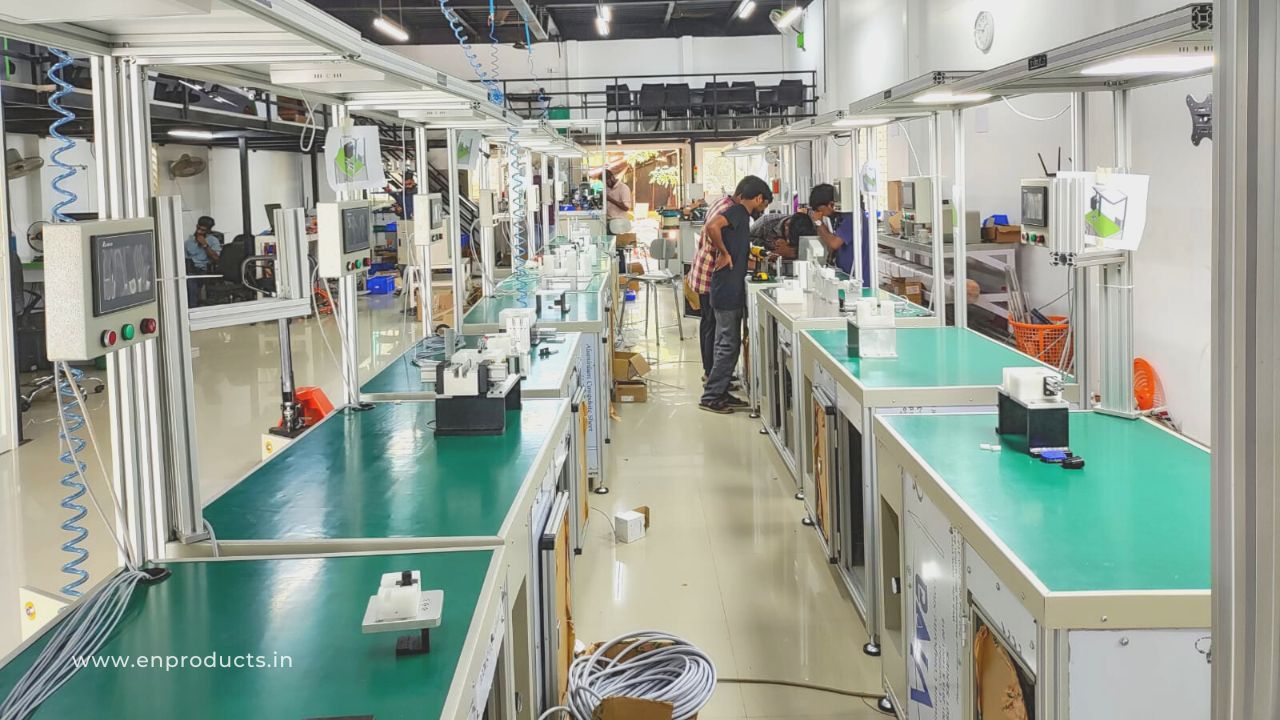
Some of the machines included in our customized assembly line solutions are listed below.
- Spool loading and unloading machines
- Cable feeder (50 kg 300 mm dia spool to 1000 kg 1000 mm dia spool)
- Cable straightener
- Cable cutting. (1 square mm. To 120 square mm)
- Cable sleeve removal
- Coaxial stripping machine
- Pneumatic stripping machines
- Cable crimping machines
- 2 ton to 20 ton servo press
- Crimping tools
- Applicator
- Connector assembly fixtures automatic, semi automatic and Manual machines
- Taping fixtures
- Heat shrink tube oven for insulation preparations
- Dip soldering machines
- Visual inspection for cable connector assembly
- Cable routing, length measurements
Frequently Asked Questions
What processes can be automated using a wire harness assembly machine?
Wire harness assembly machines can automate multiple processes including wire cutting, stripping, crimping, terminal insertion, connector assembly, soldering, and testing. This reduces manual effort and improves production consistency in high-volume manufacturing.
How does an assembly machine reduce manpower in wire harness production?
Automation reduces the number of manual operations required for repetitive tasks such as crimping, insertion, and routing. This lowers manpower dependency, reduces training effort, and improves output per operator.
Can the machine be customized for our specific harness design and production volume?
Yes. Assembly machines are designed based on your harness drawings, connector types, cycle time targets, and production volumes. Custom fixtures, tools, and automation levels are developed to match your exact process requirements.
Is the system suitable for EV wire harness and high-voltage applications?
Yes. The machines can be designed for EV harness manufacturing, including high-voltage (HV) and low-voltage (LV) systems, where precision, insulation handling, and process control are critical.
Can multiple harness variants be handled in a single assembly system?
Yes. The system can support multiple variants using programmable settings, modular tooling, and quick-change fixtures, allowing flexibility in production without increasing downtime.
How does automation improve quality in connector and terminal assembly?
Automation ensures controlled crimping force, accurate terminal insertion, and repeatable assembly cycles. This eliminates operator variation and reduces defects such as loose terminals, misalignment, and incorrect connections.
Can the assembly machine be integrated with testing systems?
Yes. The system can be integrated with continuity testers, vision inspection systems, and end-of-line (EOL) testing setups to ensure 100% validation before dispatch.
What is the typical production capacity of a wire harness assembly machine?
Production capacity depends on harness complexity, number of operations, and automation level. Machines are designed to meet high-volume production targets with stable and repeatable cycle times.
How long does it take to implement a custom wire harness assembly solution?
Implementation timelines vary based on complexity and customization. Typical timelines include design, manufacturing, testing (FAT), and installation, ranging from a few weeks to a few months.
What is the ROI of investing in wire harness assembly automation?
Automation reduces manpower costs, improves throughput, minimizes rework, and stabilizes quality. This results in lower cost per unit and faster return on investment, especially in high-volume automotive and EV production.
